2.4 Recursion
Recursion may have the following definitions: -The nested repetition of identical algorithm is recursion. -It is a technique of defining an object/process by itself. -Recursion is a process by which a function calls itself repeatedly until some specified condition has been satisfied.
2.4.1 When to use recursion
Recursion can be used for repetitive computations in which each action is stated in terms of previous result. There are two conditions that must be satisfied by any recursive procedure.
- Each time a function calls itself it should get nearer to the solution.
- There must be a decision criterion for stopping the process.
Input : n, the number whose factorial is to be found.
Output : f, the factorial of n
Method : if(n=0) f=1 else f=factorial(n-1) * n if end algorithm ends.
The general procedure for any recursive algorithm is as follows,
- Save the parameters, local variables and return addresses.
- If the termination criterion is reached perform final computation and goto step 3 otherwise perform final computations and goto step 1
- Restore the most recently saved parameters, local variable and return address and goto the latest return address.
- Many programming languages do not support recursion, hence recursive mathematical function is implemented using iterative methods.
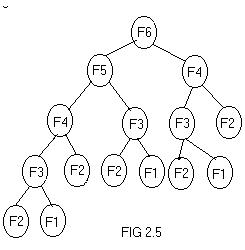
- Even though mathematical functions can be easily implemented using recursion it is always at the cost of execution time and memory space. For example, the recursion tree for generating 6 numbers in a fibonacci series generation is given in fig 2.5. A fibonacci series is of the form 0,1,1,2,3,5,8,13,…etc, where the third number is the sum of preceding two numbers and so on. It can be noticed from the fig 2.5 that, f(n-2) is computed twice, f(n-3) is computed thrice, f(n-4) is computed 5 times.
- A recursive procedure can be called from within or outside itself and to ensure its proper functioning it has to save in some order the return addresses so that, a return to the proper location will result when the return to a calling statement is made.
- The recursive programs needs considerably more storage and will take more time.
- Mathematical functions such as factorial and fibonacci series generation can be easily implemented using recursion than iteration.
- In iterative techniques looping of statement is very much necessary.

2.5 Hashing

If f(x1)=f(x2), where x1and x2 are any two variables, then x1and x2 are
called synonyms. Synonyms are mapped onto the same bucket. If a new
identifier is hashed into a already complete bucket, collision occurs.
A hashing table with single slot is as given below. Let there be 26
buckets with single slot. The identifier to be stored are GA, D, A, G,
L, A2, A1, A3, A4, Z, ZA, E. Let f(x) be the function which maps on to a
address equal to the position of the first character of the identifier
in the set of English alphabet. The hashing table generated is as shown
in fig 2.7.
Time taken to retrieve the identifiers is as follows,
| Search element (x) | Search time (t) |
| GA | 1 |
| D | 1 |
| A | 1 |
| G | 2 |
| L | 1 |
| A2 | 2 |
| A1 | 3 |
| A3 | 5 |
| A4 | 6 |
| Z | 1 |
| ZA | 10 |
| E | 6 |
| ∑t =39 |
- What are the serious short comings of the binary search method and sequential search method.
- Know more searching techniques involving hashing functions
- Implement the algorithms for searching and calculate the complexities
- Write an algorithm for the above method of selection sort and implement the same.
- Write the algorithm for merge sort method
- Take 5 data set of length 10 and hand simulate for each method given above.
- Try to know more sorting techniques and make a comparative study of them.
- Write an iterative algorithm to find the factorial of a number
- Write a recursive and iterative program for reversing a number
- Write recursive and iterative program to find maximum and minimum in a list of numbers.
- Write an algorithm to implement the hashing technique and implement the same
- Hand simulate all algorithms for a 5 datasets.

No comments:
Post a Comment